Cure your own bacon

I really can’t think of a good reason why you wouldn’t want to cure your own bacon. IT’S BACON, PEOPLE. More is better! Homemade is even better than that. So then, do you like maple bacon? Black pepper bacon? Fancy herb-spiced yuppie bacon? Do you prefer it sliced thin, thick, halfway in-between? Well guess what, you get to choose. Control your own bacon destiny!

Skip to the short version

” Stop complaining and get to work “

Ok, so perhaps you don’t own a smoker and that concerns you. Sure, a smoker makes the roasting/smoking process a little bit easier, but it isn’t a 100% requirement by a long shot. There are a lot of perfectly viable workarounds, so don’t worry too much about it. The only truly “specialty” item you’re going to need is curing salt, also known as “Prague powder #1“, “Instacure #1”, or “pink curing salt”. Himalayan pink salt is not the same thing as pink curing salt, so don’t confuse the two.
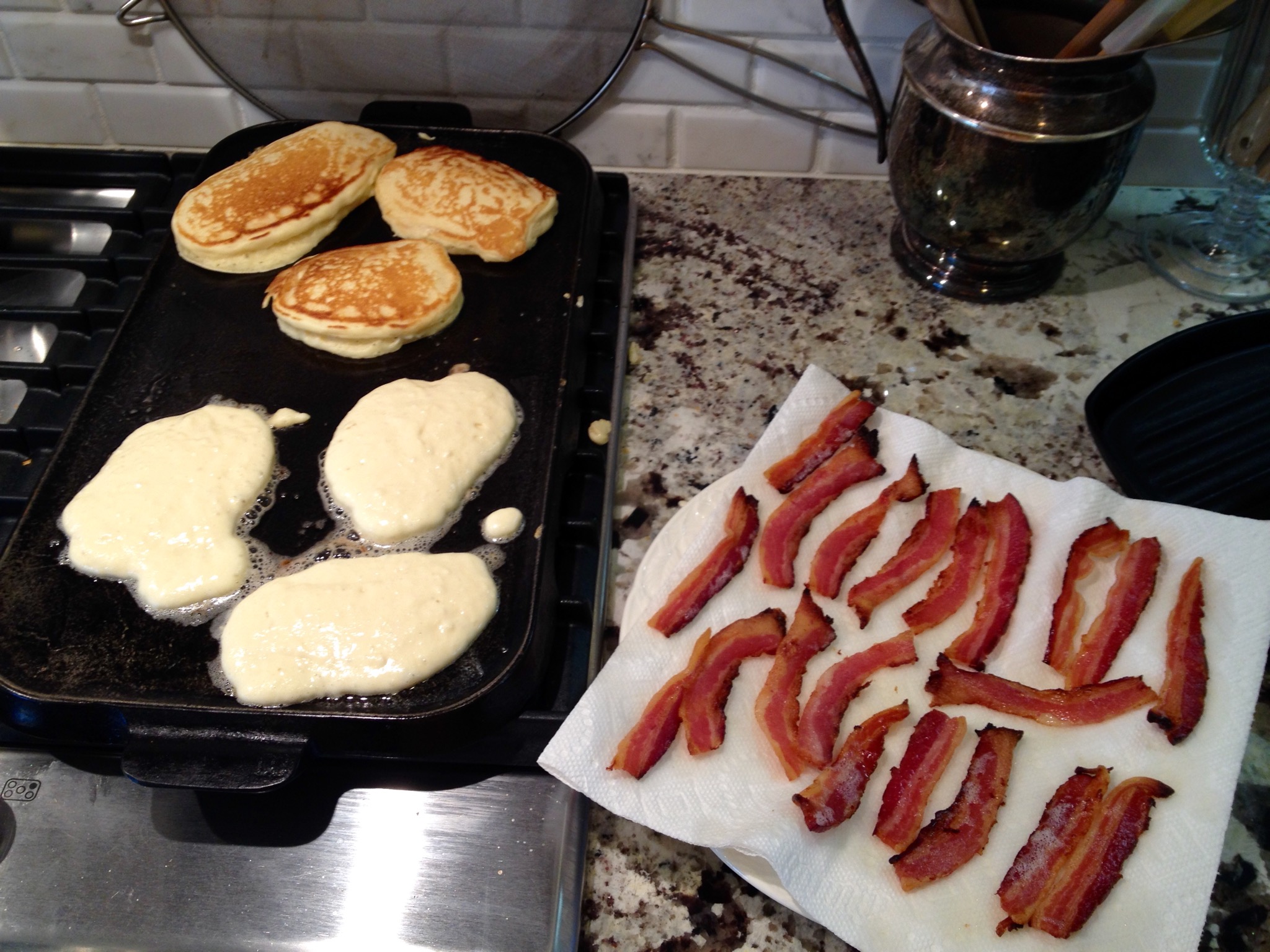
Just imagine of all the things you can do with your very own homemade bacon.

Just imagine of all the things you can do with your very own homemade bacon.

Curing isn’t anything to be afraid of. Curing salt is simply a mixture of sodium nitrite and regular old table salt. Prague Powder #1 happens to be 6% sodium nitrite and 94% regular salt and is the only type of cure you need to worry about. There is such thing as Prague Powder #2, but it contains a different ratio of ingredients and is for a completely different style of curing. What is sodium nitrite? It’s a common ingredient needed in the creation of all types of meats we know and love such as ham, pastrami, sausages, and of course bacon.

So here’s the deal. Curing requires a very specific curing-salt-to-meat ratio. Too much results in excess sodium nitrite which isn’t good for you, and too little could result in spoiled meat which is just gross. The rule is always one teaspoon of Prague Powder #1 per five pounds of meat, ground or otherwise. Easy. It’s printed right there on the container of curing salt. It gets very complicated when you start adding liquids because then you need to calculate the solution, weigh the ingredients, blah blah etc etc. If you search around the interwebs a bit you will find all sorts of opinionated rednecks arguing with one another about science and math in a very amusing manner. You will also find quite a lot of recipes that call for wildly incorrect amounts of curing salt, which is a little scary.

The good news about this particular recipe is that it’s very safe. We already know that we’re not using too much curing salt.. but what if there isn’t enough? Well even if you didn’t use any curing salt at all, the meat is refrigerated throughout the process and only “ages” for 7 days, which isn’t really enough time for it to spoil. There’s also copious amounts of regular old salt – an effective preservative – and the meat actually ends up getting cooked twice before it ever comes near your plate anyway. There, does that make you feel better? I thought so. Let’s get started then!
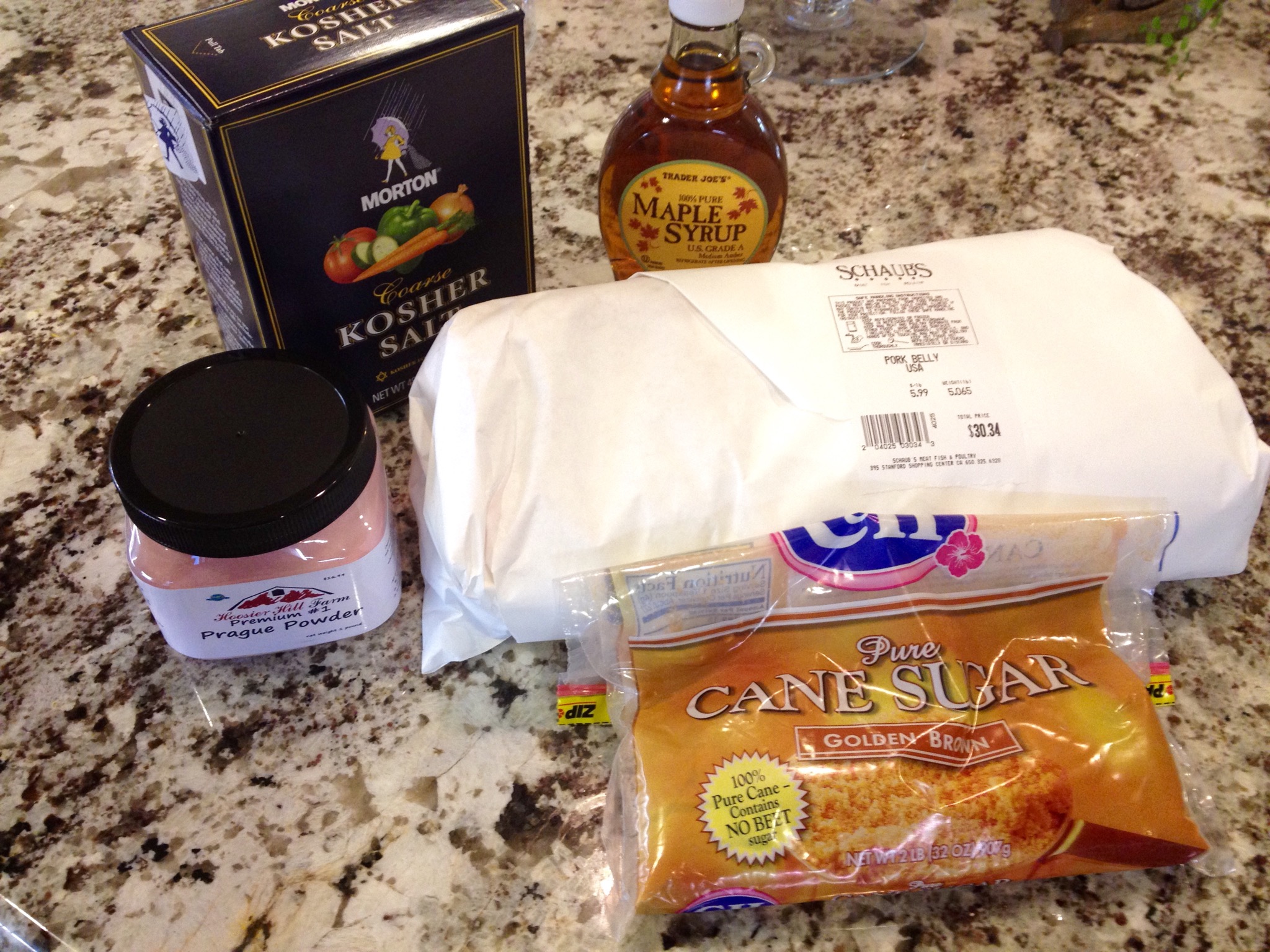
You don't need a lot of gear to cure your own bacon.

You don’t need a lot of gear to cure your own bacon.


Ingredients

  • 5 lbs fresh pork belly, skin on
  • 1 tsp Prague Powder #1
  • 1/4 cup Kosher salt -or- 1/8 cup table salt
  • 1/4 cup brown sugar, packed
  • 1/4 cup maple syrup


Other stuff you’ll need

  • a 2.5 gallon Jumbo Ziplock bag
  • a smoker or barbecue and some applewood chips
    • alternately, a normal oven and a bit of liquid smoke will work
  • a meat thermometer
  • a good, sharp knife, the longer the better


Directions

The first thing you need to do is locate five pounds of skin-on pork belly. You should be able to order one at the butcher counter in your local grocery store. Alternately, you can seek out a specialty butcher shop and see if they already have pork belly in the display case. My favorite haunt for this sort of thing is Schaub’s Meat, Fish, & Poultry in Palo Alto. They usually get their deliveries of pork on Thursday mornings, so if you’re quick about things you can often snag a hunk of belly that same day without calling ahead.
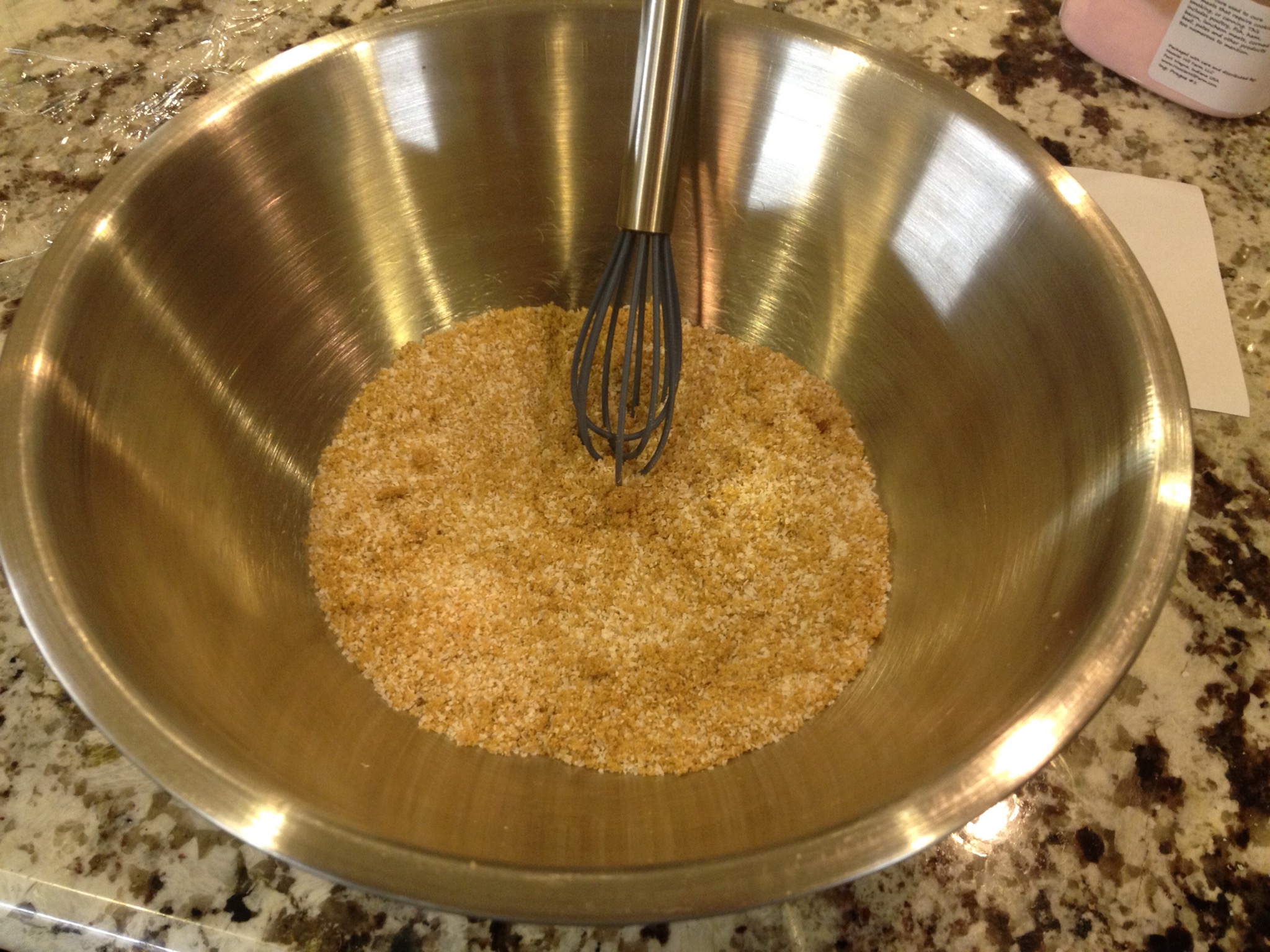
Whisking together the dry mix first helps ensure an even distribution of curing salt.

Whisking together the dry mix first helps ensure an even distribution of curing salt.

Rinse the pork belly with cold water, pat dry with paper towels, and put it in that 2.5 gallon Jumbo Ziplock bag you set aside. The next thing you want to do is whisk together all of the dry ingredients in a small bowl. Note that Kosher salt measures differently than table salt does. A good general rule is that you should double the measure when using Kosher instead of table salt or halve it when going the other way. If you want your bacon a little on the salty side, allow the measuring cup to heap a little bit, otherwise make sure it’s a level scoop. Dump the dry ingredients into the Ziplock bag right onto the belly and add the 1/4 cup maple syrup as well.
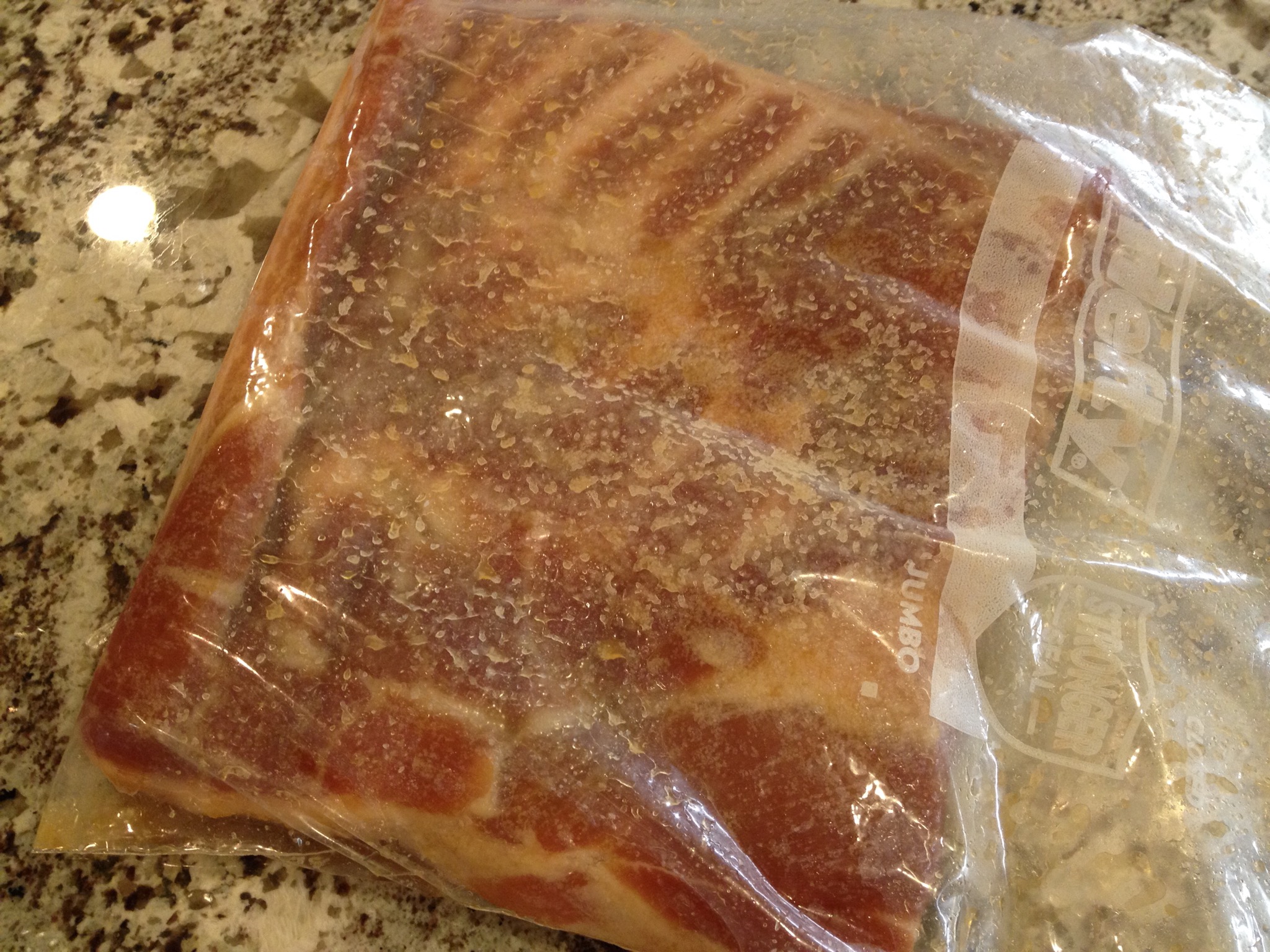
Belly in a bag. Here we go.

Belly in a bag. Here we go.

Seal the zip on the bag and smoosh the ingredients around until the belly is completely covered. You might be thinking that it’s a pain to try and rub the ingredients on inside the bag, and you would be correct. You might also think it would be a better idea to apply the rub before putting the belly in the bag and you would be wrong. Remember that it’s important to apply exactly the correct amount of cure to the meat; if we rub the cure on first, we’re going to lose a good amount on our hands and on our working surface, meaning the bacon will turn out under-cured. Applying the rub inside the bag also helps ensure the correct saltiness (and maple-y-ness) of the finished product. It only takes an extra minute or two, so stop complaining and get to work.

Once the belly is covered, lay it flat in the refrigerator and let the cure do its thing. Every day or two, flip the belly over and give it a pat and a rub to help make sure the cure is distributed evenly.
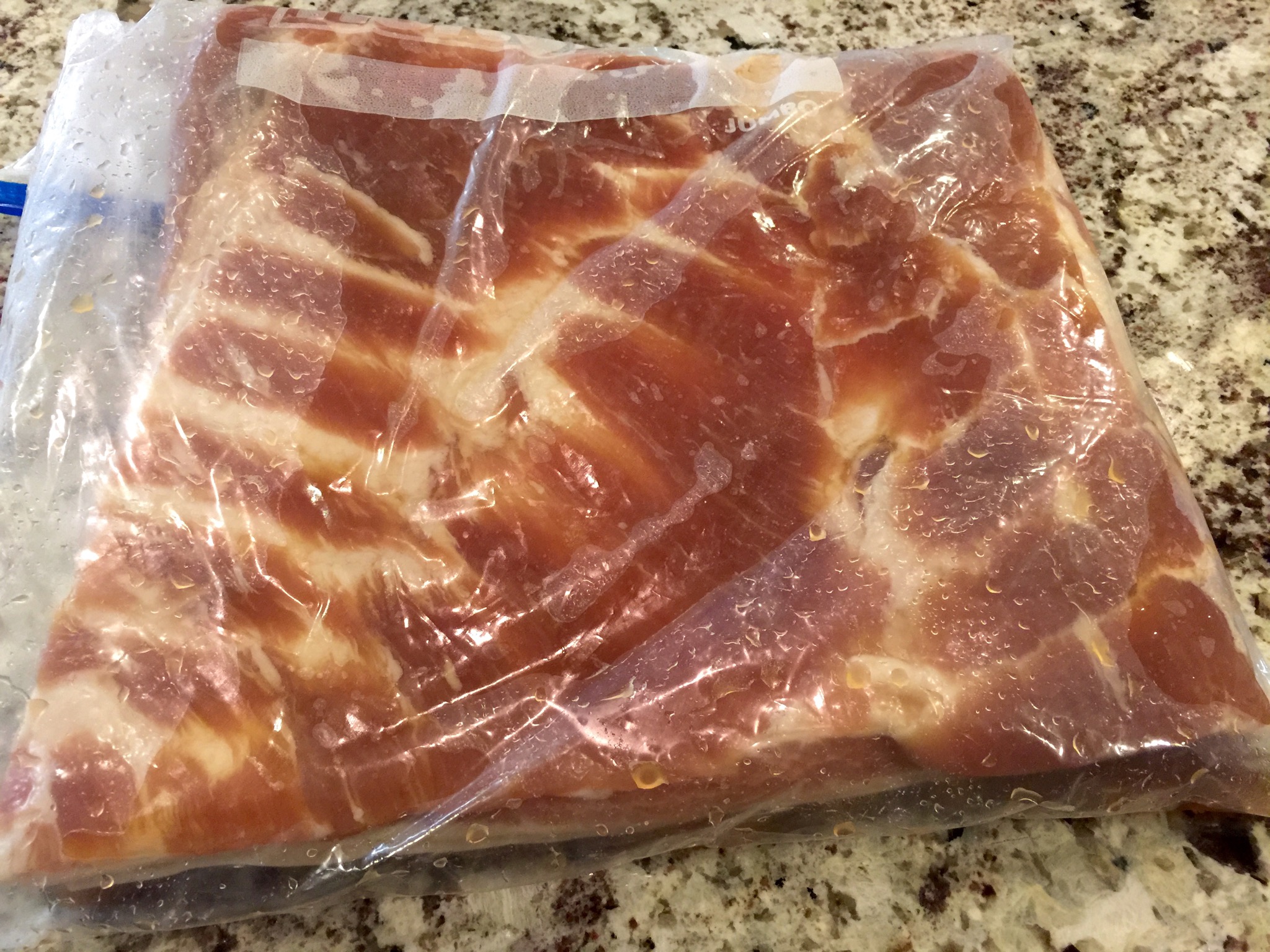
After a week of quality fridge time it should look about like this.

After a week of quality fridge time it should look about like this.

Your bacon is now officially cured, but we still have some work to do. Remove the cured belly from the Ziplock bag, rinse it thoroughly, and pat it dry with a paper towel. Some people recommend letting it hang dry in the fridge for as long as two or three days in order to form a magical barrier-like thing called a pellicle that somehow simultaneously holds in juices, allows for even cooking, and makes smoke flavor “soak in better”. Gently warming your cured belly in a 100 degree oven for an hour is supposed to do the same thing. I have never beheld the forming of this mystical meat coating myself, but I’m not about to argue with an entire Internet full of other self-titled experts who say it’s for real. Personally I don’t bother with pellicle summoning (or whatever the activity is called), and my bacon still rocks. Do it if you feel it’s a worthwhile step, otherwise don’t. Your call.
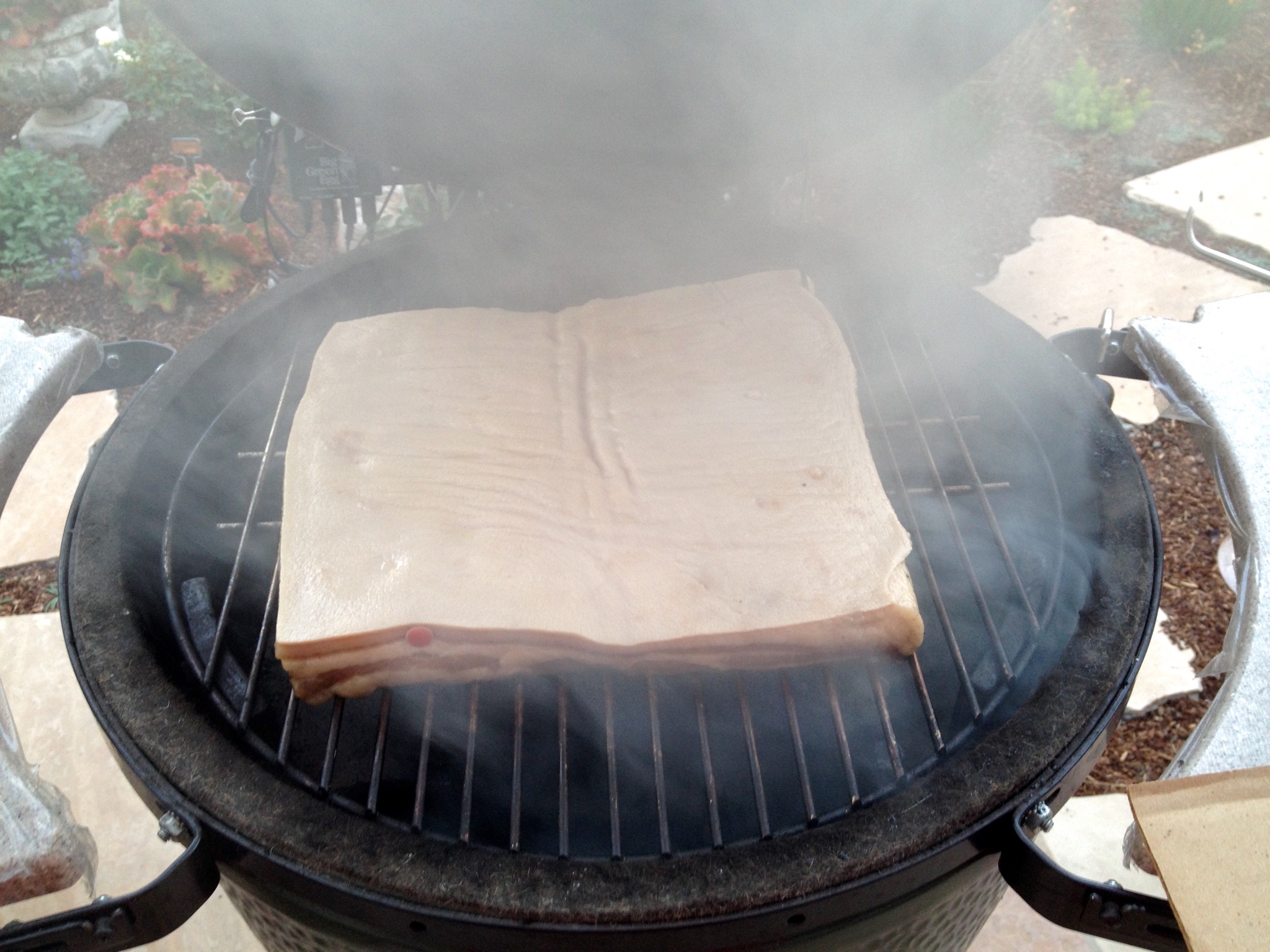
This little piggy went to the smoker.

This little piggy went to the smoker.

This next step is where the meat thermometer comes in. What we want to do is cook the belly, as slowly as possible, until the internal temperature reaches 150 degrees F. If you have a smoker, great. Set the temperature to 200 degrees F (or as close as you can get it), throw some applewood chunks or chips onto the fire, and put the cured belly skin side up on the grill for two or three hours. If you don’t have a smoker but you do have a regular charcoal or gas barbecue, configure it for low, indirect heat, and it will do just fine for smoking the cured belly. The different methods and techniques for configuring regular barbecues for indirect heat is a whole other can of worms that I won’t cover here, but I will say that there are plenty of options available to you. A regular old oven will work just fine as well, and you can still add smoke flavor by introducing a little liquid smoke to the process.
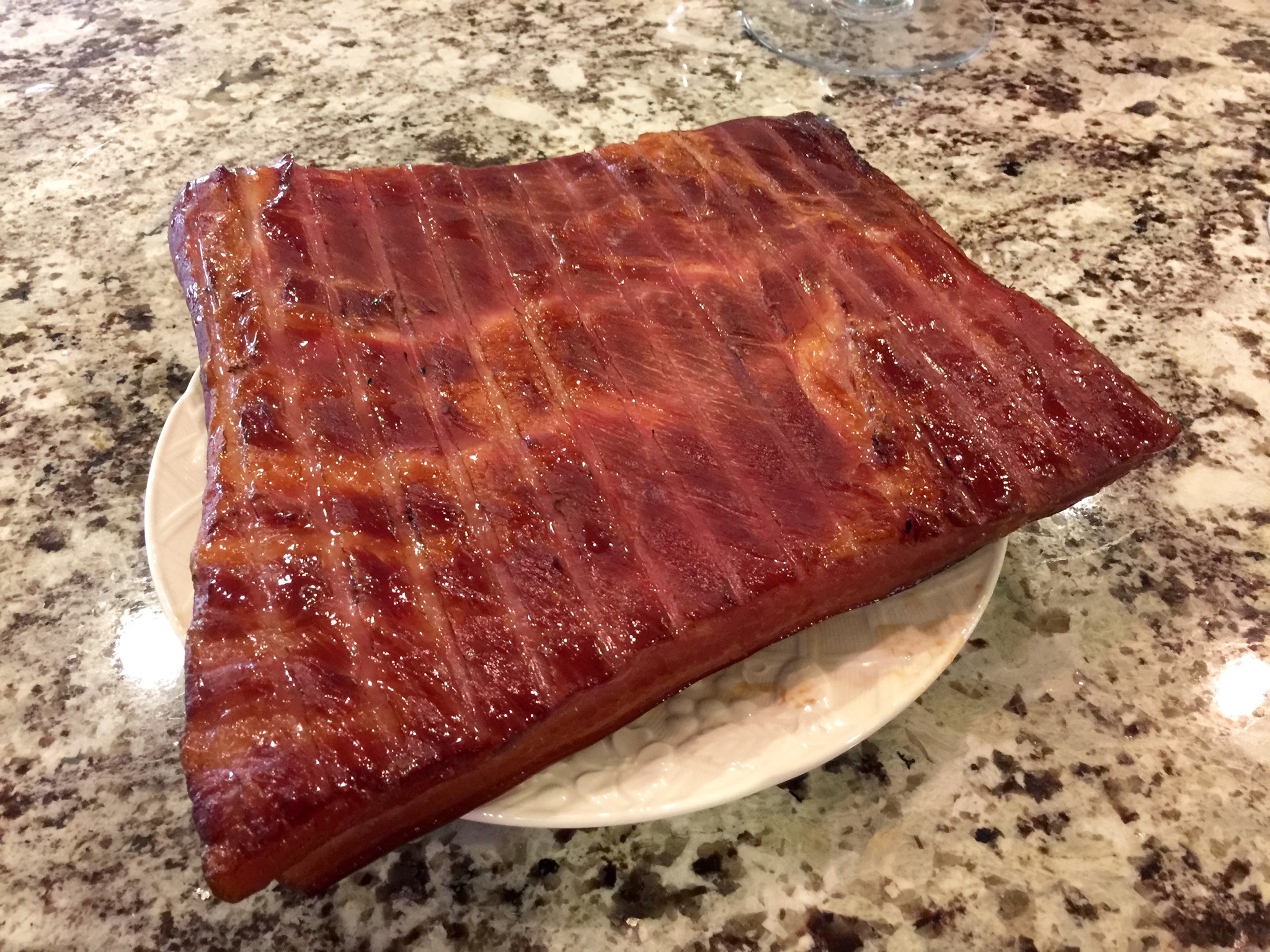
Yes, it does smell as amazing as it looks. Be jealous.

Yes, it does smell as amazing as it looks. Be jealous.

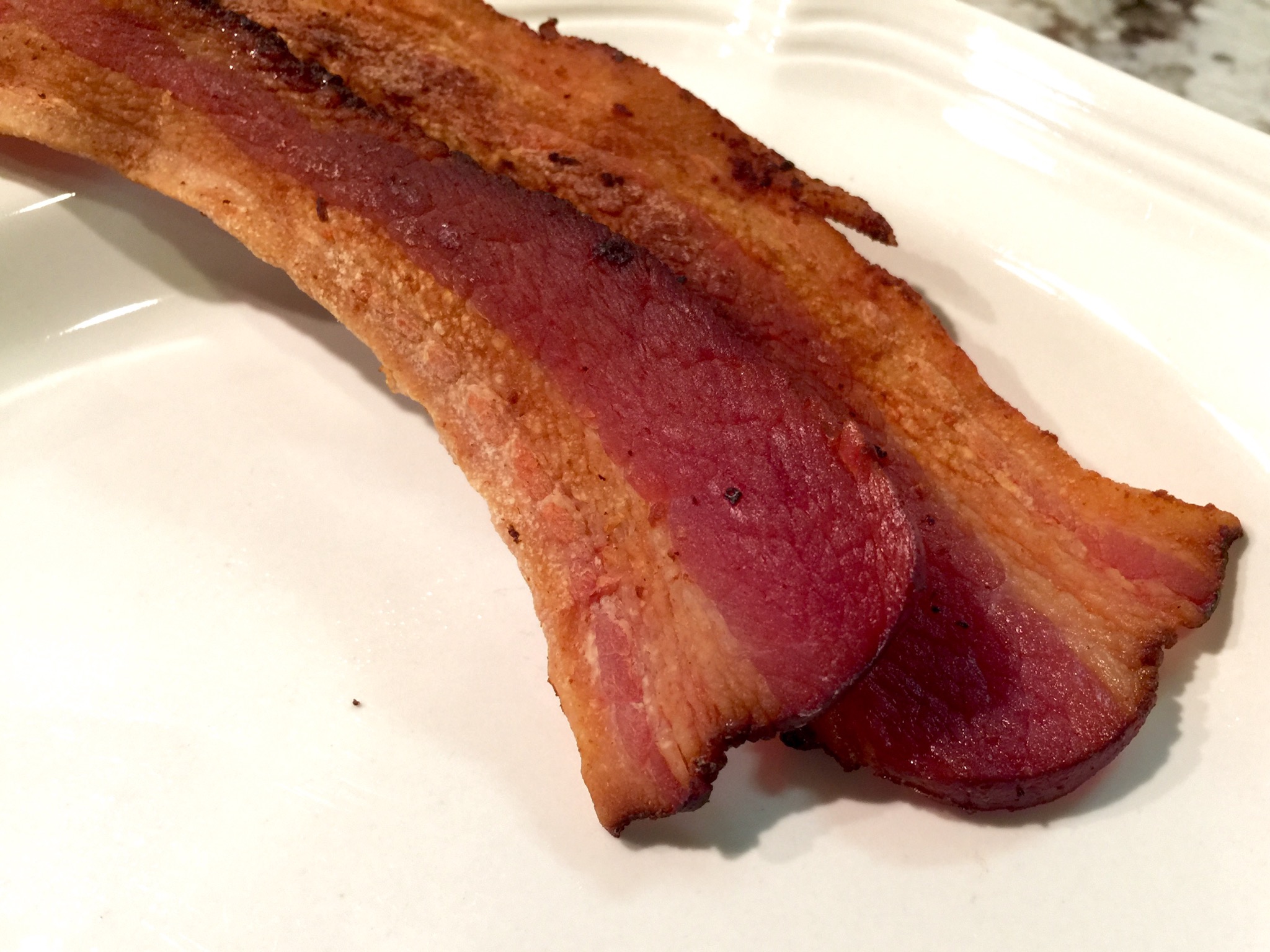
Once the belly reaches an internal temperature of 150 to 155 degrees F, remove it from the smoker/grill/oven and allow it to cool. Remove the skin while it’s still warm and stick it in the freezer for later use. That salty, smoky pig skin has all sorts of fabulous uses (e.g., chitlins, flavoring soups and beans, etc.) so definitely don’t just throw it away. What you do from here is now completely up to you. You can slice your bacon, cut it into chunks and give it away to friends, freeze it, chop it into bits and make lardons, use it as a pillow, etc. In my opinion, the very best option is to slice some of it up and make BLT sandwiches for dinner while you decide what to do with the rest. There are no bounds to what you and your bacon can accomplish together.
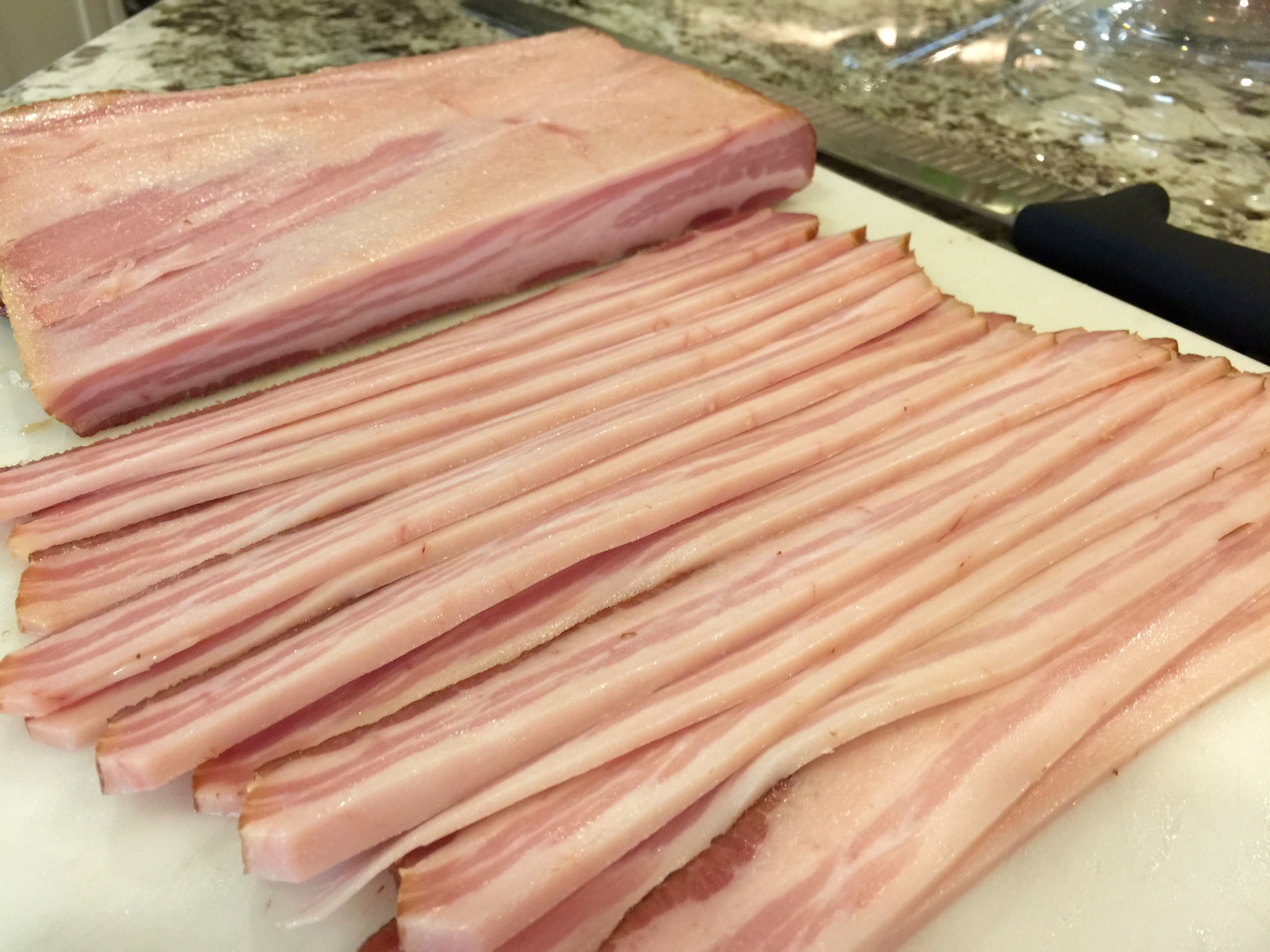
A 14

A 14″ brisket knife and a steady hand make for nice, even strips.

Now that you know how to cure your own bacon, you can start messing with the recipe a bit. Just remember that it’s always one teaspoon of Prague Powder #1 to five pounds of belly in a dry (or mostly dry) mix. From there do whatever you like. Add spices, pepper, bay leaves, espresso… pretty much anything really. Get out there and conquer your own world of bacon.


tl;dr

Cure your own bacon

Ingredients

  • 5 lbs fresh pork belly, skin on
  • 1 tsp Prague Powder #1
  • 1/4 cup Kosher salt
  • 1/4 cup brown sugar, packed
  • 1/4 cup maple syrup


Other stuff you’ll need

  • a 2.5 gallon Jumbo Ziplock bag
  • a smoker or barbecue and some applewood chips
  • a meat thermometer
  • a sharp knife


Directions

Rinse pork belly with cold water, pat dry with paper towels, and place in Jumbo Ziplock bag. Whisk together dry ingredients, stir in maple syrup, and add to bag. Seal zip on bag and work cure mixture around until entire belly is covered. Place in refrigerator for at least 7 days, flip daily. Remove belly from bag and thoroughly rinse in cold water. Smoke at 200 degrees F until internal temperature of belly reaches 150 to 155 degrees F. Remove skin while warm, cut bacon into slices and refrigerate or freeze.


See also


*attempts to eat computer screen*

*attempts to eat computer screen*


Standard Recipe Disclaimer
I don’t come up with a lot of my own recipes (unless you count my own personal milk-to-Grape-Nuts ratio), and chances are the recipe posted above belongs to or was inspired by a person other than me. So if you’re wondering whether or not I ripped somebody off, I probably did. Don’t get out the pitchforks and torches just yet though! I want to make absolutely sure I give credit where it’s due, so if you think someone deserves recognition for something that I haven’t already called out FOR CRYING OUT LOUD LET ME KNOW. Thanks, I appreciate it. Here’s a cookie.

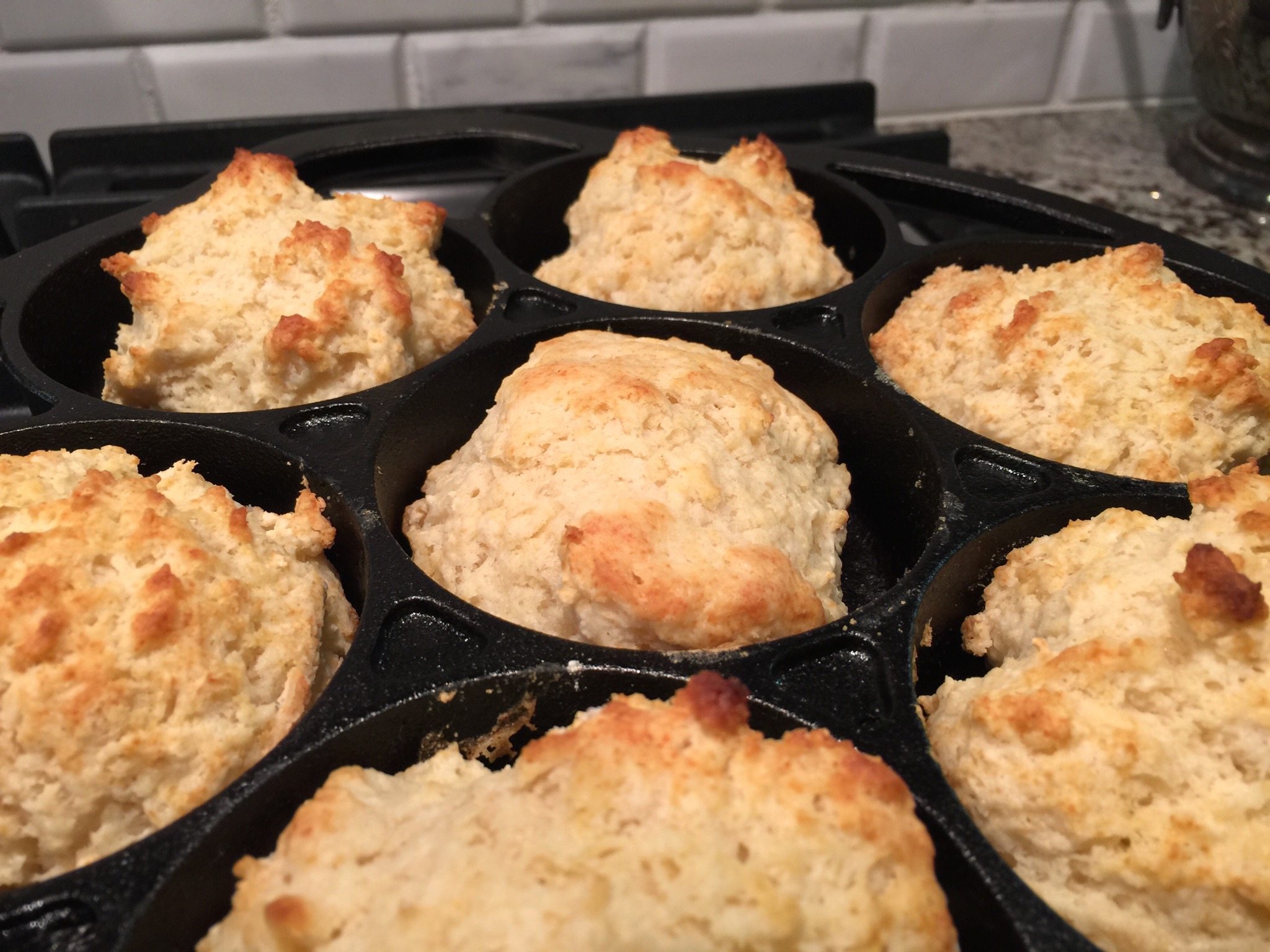
Buttermilk drop biscuits

Everybody loves biscuits. There’s no arguing with this statement. I’m not talking about the flat, sweet, crunchy things that folks on the other side of the Atlantic call biscuits (although those are good too), I’m talking about flaky, buttery, American-style biscuits. If you’ve never had one of these fresh out of the oven, you haven’t lived.

Skip to the short version

THESE are biscuits. End of story.

THESE are biscuits. End of story.

I’ve made a lot of rolled biscuits in the past, the kind where you roll out the dough and cut circles out with a cutter, but lately I’ve taken to drop biscuits. They get their name from the fact that are formed by taking rough scoops of dough and dropping them onto a sheet or pan; no rolling pin necessary. Drop biscuits require less work and therefore less handling, which – for me at least – results in a lighter texture. They are also more versatile than their rolled cousins, and they do rather well with additional ingredients mixed in like cheese or hunks of bacon.


Ingredients

  • 3 cups all purpose flour
  • 2 tablespoons sugar
  • 4 teaspoons baking powder
  • 1 teaspoon baking soda
  • 1 teaspoon salt
  • 3/4 cup (1.5 sticks) unsalted butter
  • 1 cup buttermilk …give or take a bit. More on this later.


Directions

” If Satan has a favorite drink, it’s buttermilk “

Preheat your oven to 425 degrees F. If you happen to be using a cast iron drop biscuit pan, preheat it with the oven. Whisk together the dry ingredients in a large bowl. Now we need to incorporate the butter into the dry ingredients, probably the trickiest bit of the whole process. The most straightforward way to go about it is just to plop the butter as-is directly into the flour mixture and go to work with a pastry blender. If you don’t happen to have one of these (and even if you do), this step can be a pain in the arse. You can try chopping up the butter before dumping it into the flour and using table knives or forks to work it in, but it’s a tedious process. Or………


Optional super-cool way of doing things

Put your 1.5 sticks of butter in the freezer and leave them there for several hours, preferably overnight. Put a cheese grater in there as well.

Yes, you read that correctly. Put a cheese grater in the freezer. I’m serious.

Guess what we're going to do next.

Guess what we’re going to do next.

When the butter is frozen solid, carefully remove it from the wrapper, handling it as little as possible. Using your icy-cold cheese grater, quickly grate the butter into the dry ingredients and mix them together. If you have trouble with the butter clumping together, put your dry ingredients in the freezer for 30 minutes first.

I bet you've never seen grated butter before, have you?

I bet you’ve never seen grated butter before, have you?

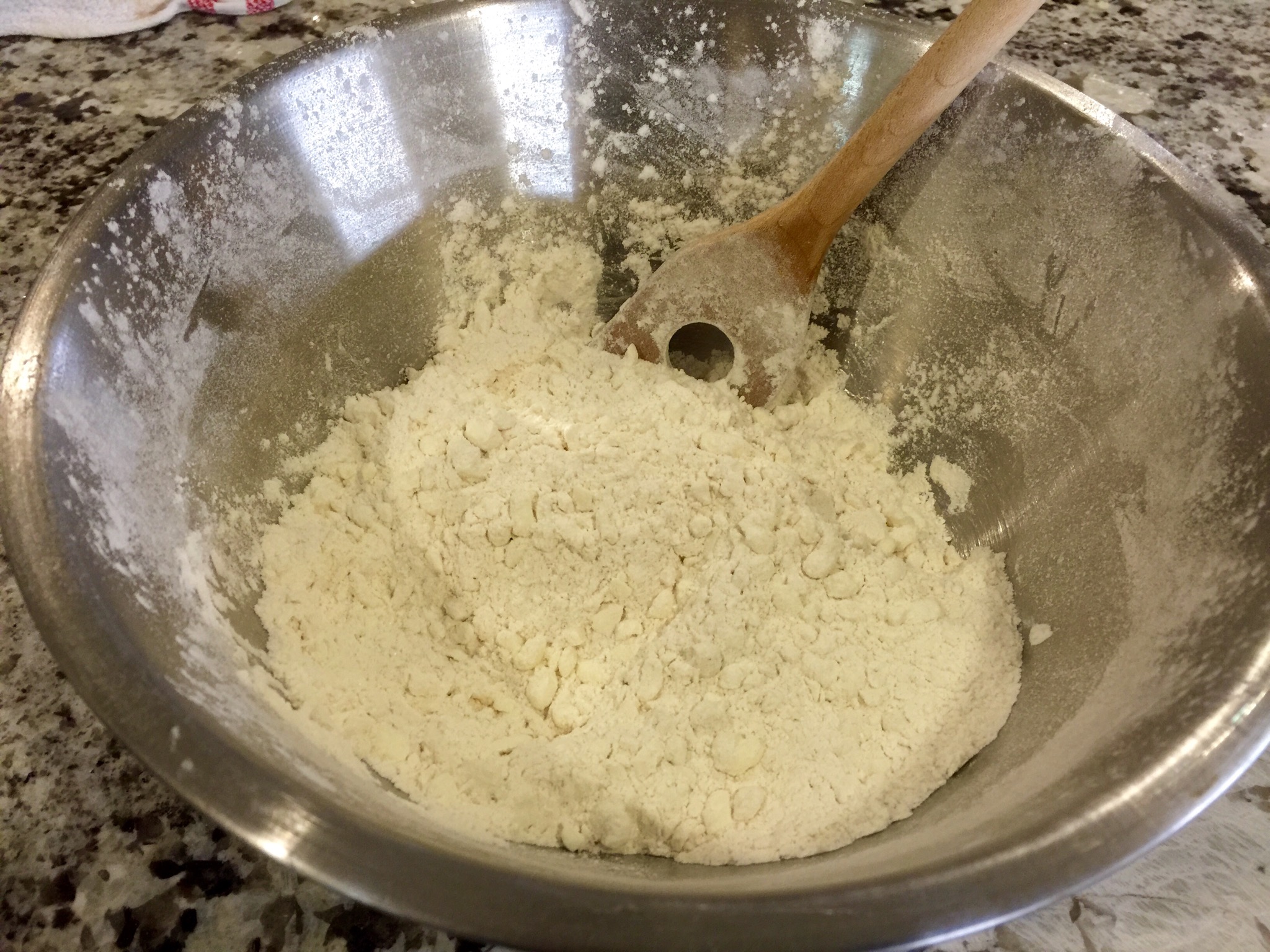
Regardless of which method you use to get the butter worked into the dry ingredients, you should end up with a coarse, crumbly-looking mixture with pea-sized lumps of butter. If you want to include additional ingredients (e.g., cheese), now is the time to add them. If this is your first time making drop biscuits, I recommend sticking with the basic recipe to get a better feel for things. Either way, it’s now time to add the buttermilk.

It's not an exact science. Just get your dry mix to look more or less like this.

It’s not an exact science. Just get your dry mix to look more or less like this.

Before we go any further, let me just say that buttermilk is NASTY. Don’t ever try it straight up. My friends and family will tell you that I’m grossly exaggerating things, but don’t listen to them. Buttermilk is one of the most horrific things I have ever tasted – my first tentative sip gave me nightmares for a week. It’s like rotten milk mixed with motor oil and rattlesnake venom. If Satan has a favorite drink, it’s buttermilk, I’m sure of it. It’s a mystery to me how such a repulsive ingredient can make such delicious biscuits, so I’m just going to chalk it up to magic and move on with my life.

Earlier, in the ‘ingredients’ section, I mentioned that you should use one cup of buttermilk, give or take a bit. What I mean by this is that the exact amount of liquid you should use cannot be easily determined ahead of time. When it comes to recipes like this one, it’s far more important for the dough to have the right consistency than to use a precise measurement. As my grandmother used to say when teaching me recipes, “Add enough until it’s right.” So, one cup of buttermilk is probably about the right amount, but don’t be alarmed if you need to add a bit more to make the dough firm up correctly.

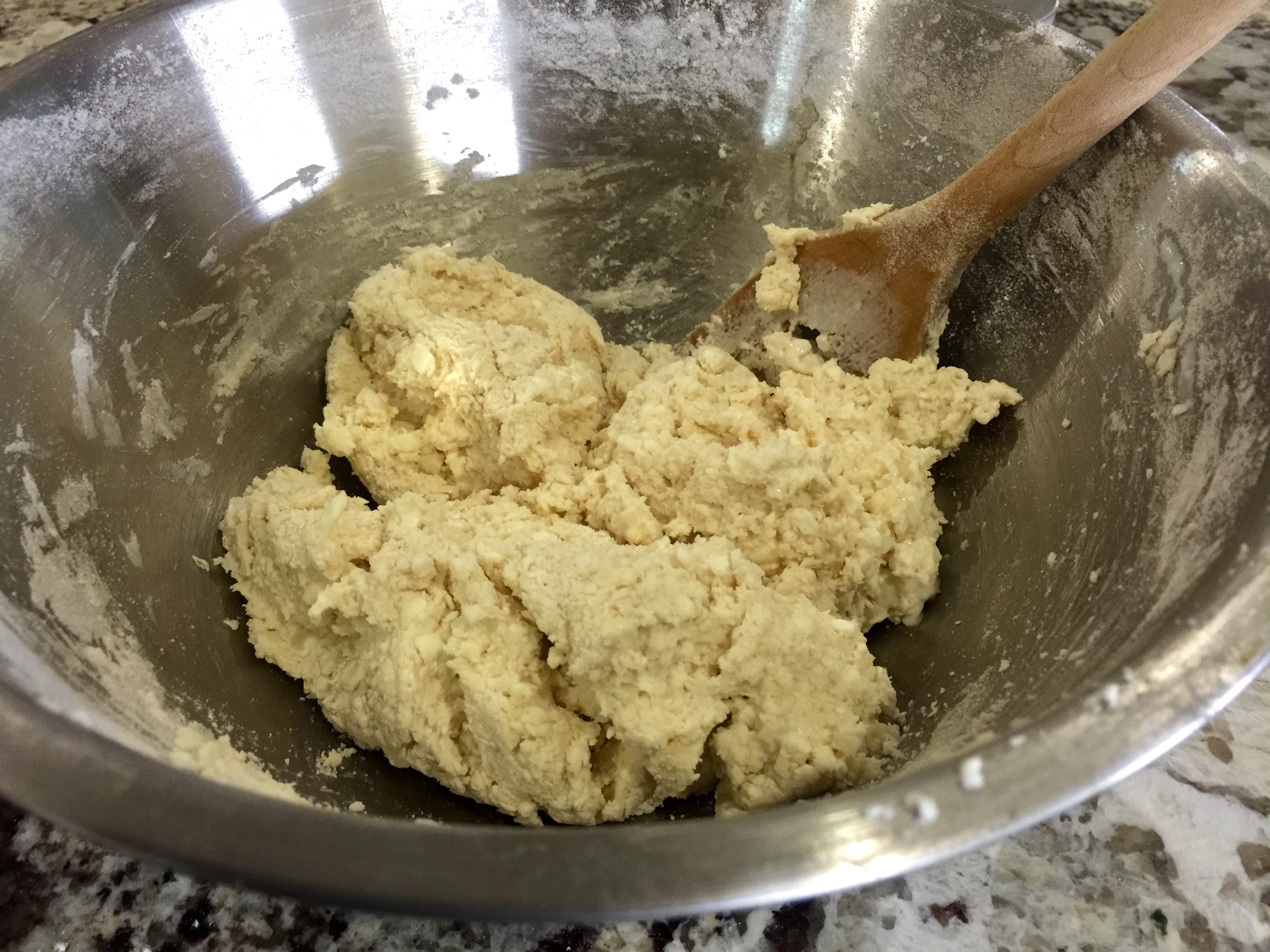
Use a measuring cup if it makes you feel better, but I don’t even bother with one. Pour some buttermilk into the dry mix and stir it in gently, being careful not to over-work the dough. If you mix the bejesus out of it, your biscuits will turn out chewy and manhandled instead of flaky and light, so use a gentle hand. It will soon be apparent if there is not enough liquid in your dough because it will be powdery in areas and won’t want to hold together. Add another splash of buttermilk – no more than a tablespoon at a time – and turn over the dough a few more times with your mixing spoon. Keep adding liquid as necessary until you get a single, sticky mess of thick dough that stands up all by itself in the center of the bowl.

And this is what biscuit dough should look like.

And this is what biscuit dough should look like.

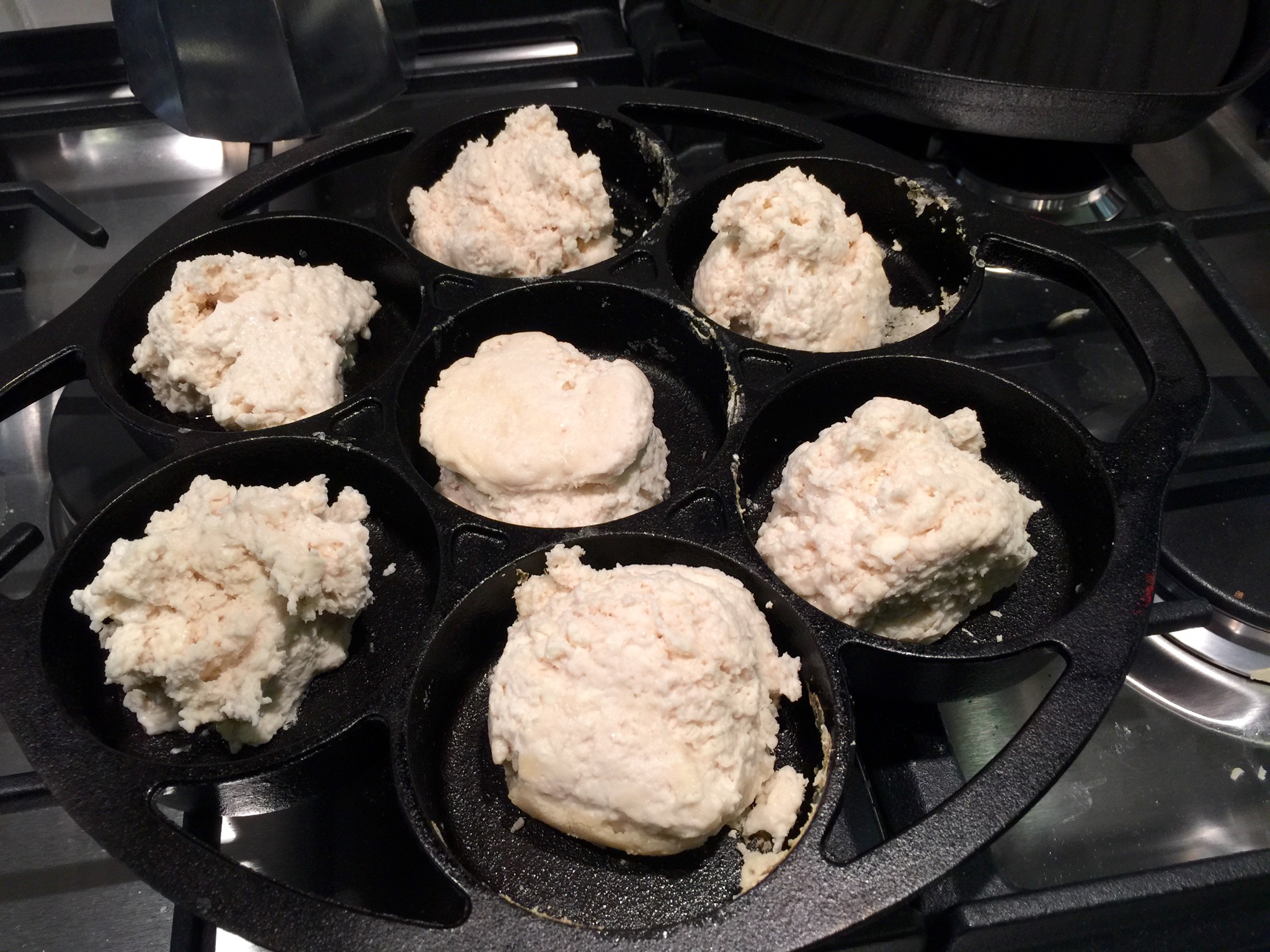
Now comes the fun part. Drop quarter-cup lumps of dough onto a baking sheet (or your preheated drop biscuit pan) and bake for 15 minutes.

They don't have to be pretty. In fact, it's better if they aren't.

They don’t have to be pretty. In fact, it’s better if they aren’t.

When the tops of the biscuits are golden brown and toasty, they are ready to consume. Serve them hot and with plenty of butter, sausage gravy, honey, jam, or whatever your heart desires.

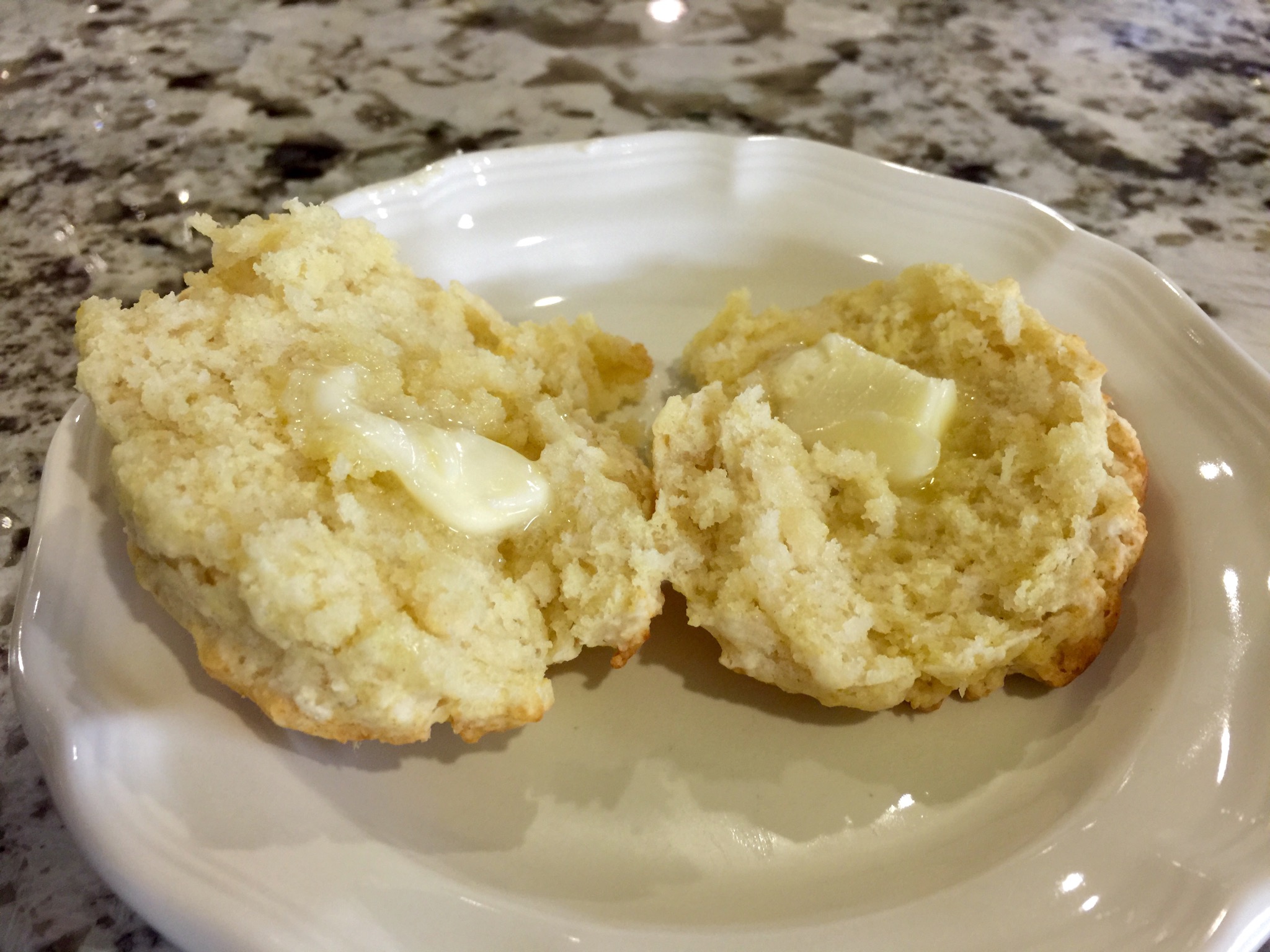
It's all worth it for this one buttery moment.

It’s all worth it for this one buttery moment.


tl;dr

Buttermilk drop biscuits

Ingredients

  • 3 cups all purpose flour
  • 2 tablespoons sugar
  • 4 teaspoons baking powder
  • 1 teaspoon baking soda
  • 1 teaspoon salt
  • 3/4 cup (1.5 sticks) unsalted butter
  • 1-1.5 cups buttermilk


Directions

Preheat oven to 425 degrees F. Whisk together the dry ingredients in a large bowl. Incorporate butter into dry ingredients with a pastry blender or by grating butter while frozen. Add buttermilk until all dry ingredients have been incorporated. Drop quarter-cup lumps of dough onto a baking sheet or preheated drop biscuit pan and bake for 15 minutes.


See also


A bacon and cheese variant I made recently. They did not suck.

A bacon and cheese variant I made recently. They did not suck.


Standard Recipe Disclaimer
I don’t come up with a lot of my own recipes (unless you count my own personal milk-to-Grape-Nuts ratio), and chances are the recipe posted above belongs to or was inspired by a person other than me. So if you’re wondering whether or not I ripped somebody off, I probably did. Don’t get out the pitchforks and torches just yet though! I want to make absolutely sure I give credit where it’s due, so if you think someone deserves recognition for something that I haven’t already called out FOR CRYING OUT LOUD LET ME KNOW. Thanks, I appreciate it. Here’s a cookie.


Choose Your Own Restaurant Review


It’s a hot day in California, as hot as fresh jalapenos. The air feels like a pizza oven. The corn-yellow sun shines its rays like yet another stupid food-based metaphor that you can’t be bothered to think of. Suddenly, you remember that you are a food blogger. A feeling of mild panic mixed with hunger starts in your gut and works its way into your eyelid, making it twitch.

“I really should go eat at a restaurant somewhere,” you say to yourself, thoughtfully placing a hand over your gurgling stomach. The three people that have been sitting on the couch in your living room look at you suddenly, concerned to see you speaking to yourself yet again. “Oh,” you say, attempting to salvage the situation. “Do you guys…”

Choose: “…want to go to an Italian restaurant?”

Choose: “…have any ideas where we should go?”


.

.

.

.

.

.

.

.

.

.


You suggest going to an Italian restaurant.

Everyone seems to like the idea of Italian, and without much fuss you all climb into the car and start driving towards a half-decent chain restaurant. As you cruise down the street, you notice a biplane towing a banner overhead… and then you remember. There’s a 49er game today, and you are heading straight into the belly of the beast. Quick, you need to avoid traffic! You decide to…

Choose: Take the freeway.

Choose: Take side streets.


.

.

.

.

.

.

.

.

.

.


You ask for advice on where you should go eat.

Seizing the opportunity to dictate the menu, the pickiest eater of the group leaps to his feet and begins listing restaurant criteria. “It should be not too expensive and not too cheap, but also not greasy and probably there should be no cheese. Except if we go to my favorite burrito place, then grease and cheese are ok,” he says, hardly taking a breath. “It can’t be Chinese because I demanded to have that yesterday and now I am tired of it, and it can’t be American or Greek or Burmese or Lithuanian or African or basically anything that I say it can’t be. In fact, it must only be a very specific type of curry, my aforementioned favorite burrito shop, or a pizza place an hour away. Also…”

But those are the last words he ever says. The other two people in the room throttle the picky eater to death with their bare hands, and you help them bury the body. Eventually you are all caught by the FBI and are sent to prison for the rest of your natural lives.

Go back


.

.

.

.

.

.

.

.

.

.


You take the freeway.

In a stroke of sheer luck, traffic on the freeway is very light… but in the wrong direction. You have no choice but to try and get away from the football crowd, so you start driving with no destination in mind. Before long you realize you are headed straight towards Murphy Street in Sunnyvale, and you know for sure that there are some decent places to eat there. Maybe things will turn out alright after all. Quickly, you park the car and shoo everyone in the general direction of food. You walk along Murphy Street and then…

Choose: You go to the kebab joint.

Choose: You go to the Italian bistro.

Choose: You go to the Mexican place.


.

.

.

.

.

.

.

.

.

.


You take side streets.

Using local shortcuts is always a good choice… right? After only a couple of blocks you realize you have made a terrible, terrible mistake. You are stuck right in the middle of the worst gridlock you have ever seen, surrounded by raised pickup trucks draped in 49er flags. You are trapped and there is no way out.

You're screwed now.

You’re screwed now.

The starvation slowly drives your passengers to insanity over the course of the next twelve days. Eventually, it is decided that cannibalism is the only path to survival… and you are the main course.

Go back


.

.

.

.

.

.

.

.

.

.


You walk towards the kebab joint.

As you draw near to the kebab joint, you hear your stomach grumbling… but then you realize it’s someone in your party voicing their disapproval of kebabs. Well, it’s not the worst thing ever. The sun-faded posters in the window of this place look kind of scary anyway, and there are way too many dead flies on the inside window sills. Yucky. You turn back to pick another place to eat.

Go back


.

.

.

.

.

.

.

.

.

.


You arrive at the Italian bistro.

The place is packed to the gills, even the outside patio. “Ugh,” you mutter to yourself. “What in the world are all these people doing here at 1pm on a Sunday??”

“It looks like they’re watching the football game on that giant portable TV screen they’ve parked in the middle of the road over there,” says one of your starving companions.

Sigh. It seems Italian just isn’t meant to be today. Disappointed and somewhat depressed, you turn around and walk back up the street to choose from one of the other two restaurants.

Go back


.

.

.

.

.

.

.

.

.

.


You decide on the Mexican place.

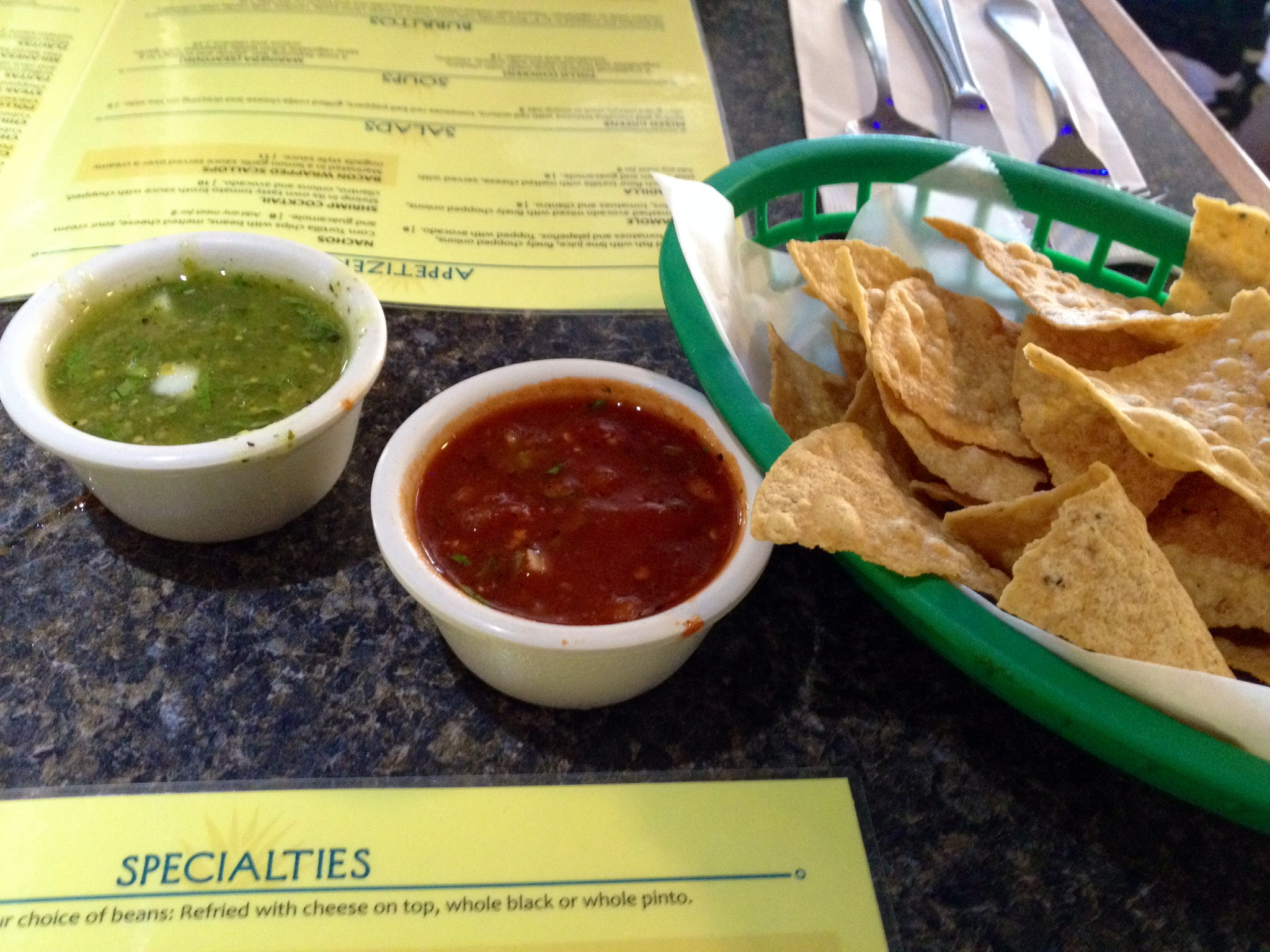
You find yourself at Roberto’s Cantina, a small-ish place tucked in a corner along Murphy Street. The scent of delicious, scratch-made Mexican food meets your nose, and to your surprise there are still a couple of tables open. You are quickly seated and given some chips and salsa to graze on.

You discover that both types of salsa are excellent.

You discover that both types of salsa are excellent.

You spend some time looking through the menu, and a few different entrees catch your eye. The waiter arrives and asks you what you’d like to order.

Choose: A combination plate.

Choose: Al Rebozo (bacon-wrapped shrimp).

Choose: Steak fajitas.


.

.

.

.

.

.

.

.

.

.


You order a combination plate.

You figure that the best way to try out a new Mexican restaurant is to go for a mix of favorites. You opt for a carne asada enchilada and a quesadilla, and of course refried beans instead of pinto or black beans.

C-C-C-COMBO BREAKER!

C-C-C-COMBO BREAKER!

You find the refried beans to be flavorful but mostly average, a sure indicator of the rest of the meal. The quesadilla is about the same, but the enchilada turns out to be rather good. It is unfortunately impossible to eat, being nestled in a shallow bowl and inaccessible to knife and fork, but you still enjoy it. Without warning, your spouse asks you for half of your quesadilla in exchange for a couple of bacon-wrapped shrimp.

Accept the trade and give the shrimp a try.

Refuse the trade and keep your quesadilla.


.

.

.

.

.

.

.

.

.

.


You try the Al Rebozo.

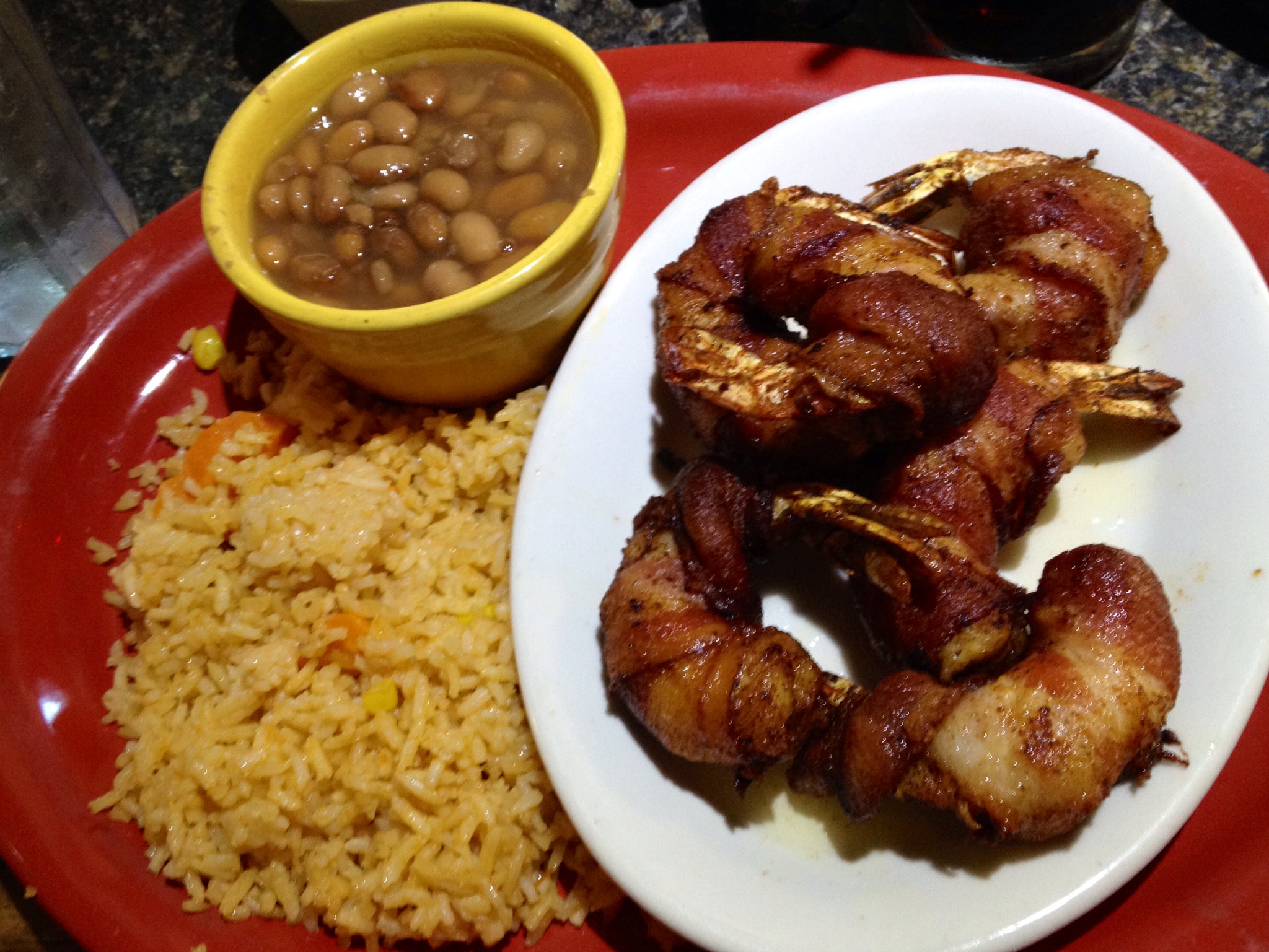
You’re not sure who Al is, but apparently he makes pretty decent bacon-wrapped shrimp. The scent of crispy bacon and fresh seafood wafts tantalizingly through the air.

When in doubt, wrap everything in bacon.

When in doubt, wrap everything in bacon.

You’ve had questionable bacon-and-shrimp plates before, so you’re not really sure what to think of this one. You tentatively take a bite… and wow! That is one tasty dish. The bacon is nice and crispy, but surprisingly the shrimp inside are not overcooked. Whoever is preparing this dish has apparently done this before, and they are very good at it. You decide that these shrimp are so tasty, in fact, that you would even eat them if they were served on top of a dried cow pie. You aren’t too sure about the weird chipotle sauce that came with them though.

Conclude your meal.


.

.

.

.

.

.

.

.

.

.


You order steak fajitas.

Hey, who doesn’t like fajitas? Unfortunately, the answer will soon be you. The steak fajitas arrive piled high, sizzling on a cast iron thingy and smelling delicious. As you begin eating, however, you realize that they don’t have a lot of flavor, and the tortillas are a little odd as well. You probably should have ordered something else.

Go back


.

.

.

.

.

.

.

.

.

.


You foolishly refuse the trade.

Like an idiot, you decide that it’ll be a good idea to decline your spouse’s trade. You greedily hoard the remainder of your combo plate for yourself, all the while being given the hairy eyeball. Later, when you arrive at home, you are assigned to pull weeds in the hot sun for the rest of your life. That evening, your PlayStation mysteriously appears in the toilet.

Rethink your decision


.

.

.

.

.

.

.

.

.

.


You finish your meal and wrap up the restaurant review.

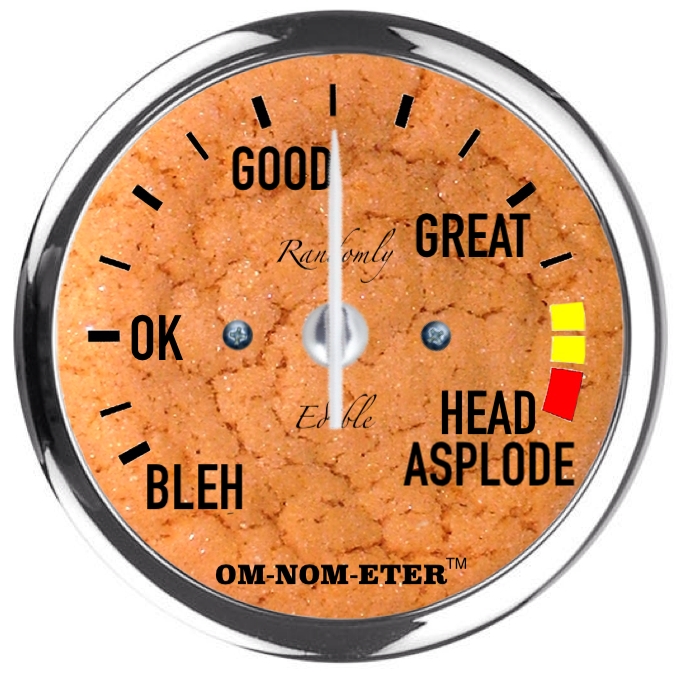
meter-good+In the end, you consider your experience at Roberto’s Cantina to be a success. All four people in your lunch party – including the picky one – ended up mostly happy with their meals. There were a couple of things about Roberto’s that you didn’t love, such as the flavorless carne asada and fajitas, but there were also some things that you thought were pretty good. You’d be happy to come back some day, but you can’t give it the highest score ever. You decide to rate this restaurant 7 out 10 pork-wrapped seafood items.

And then everyone lived happily ever after.

Roberto’s Cantina
168 South Murphy Avenue
Sunnyvale, CA 94086
(408) 739-2021
www.robertos-cantina.com

Roberto's Cantina on Urbanspoon


Standard Restaurant Review Disclaimer
The ambiguous and illogical rating system used in this review is not intended to be pinpoint accurate. It’s only there to give you a general idea of how much I like or dislike an establishment, and it also gives me an excuse to write silly things. If my rating system angers and distracts you, there’s a good chance you have control issues. I would also like to point out that I am not a highly qualified restaurant reviewer person, nor do I particularly care what that job is called. If you were under the impression that perhaps I was one of those people, consider your hopes dashed. Lastly, wow! You read the entire disclaimer. You get a gold star on your chart today.